

CKD Storage Electric Water Heaters: What Buyers Should Check
Why CKD orders are decided on details, not on price
CKD purchasing looks like a straightforward cost comparison: a kit should be cheaper to import than a finished unit. In practice, the projects that go wrong rarely fail on price. They fail on kit scope, liner specification, certification responsibility, or customs classification — issues that surface only after the container has arrived.
For importers and assemblers in India, Indonesia, Vietnam, Thailand, Egypt, Turkey, and the wider Southeast Asian and Middle East markets, these ten checks are what separate a repeatable CKD programme from a one-off shipment.
1. Define exactly what “CKD” means in your project
The industry uses CKD, SKD, and CBU loosely. Before quoting, agree on the kit scope in writing:
| Term | What it normally means | What the buyer must be able to do |
|---|---|---|
| CBU | Complete unit, ready to install | Retail or light assembly only |
| SKD | Semi-knocked down: major assemblies pre-built | Final assembly, wiring, testing, packaging |
| CKD | Component kits: parts grouped by assembly stage | Tank assembly, wiring, pressure and electrical testing, packaging |
There is no universal definition. A supplier’s “CKD” may include an enamelled liner, flanges, heating element, thermostat, and safety components; another may ship only the liner and fittings. Ask for a bill of materials with part numbers and quantities per unit — not a description.
2. Confirm the liner standard and pressure rating
The liner is the heart of a storage water heater and the part that is hardest to replace locally. Two questions decide whether a kit is viable:
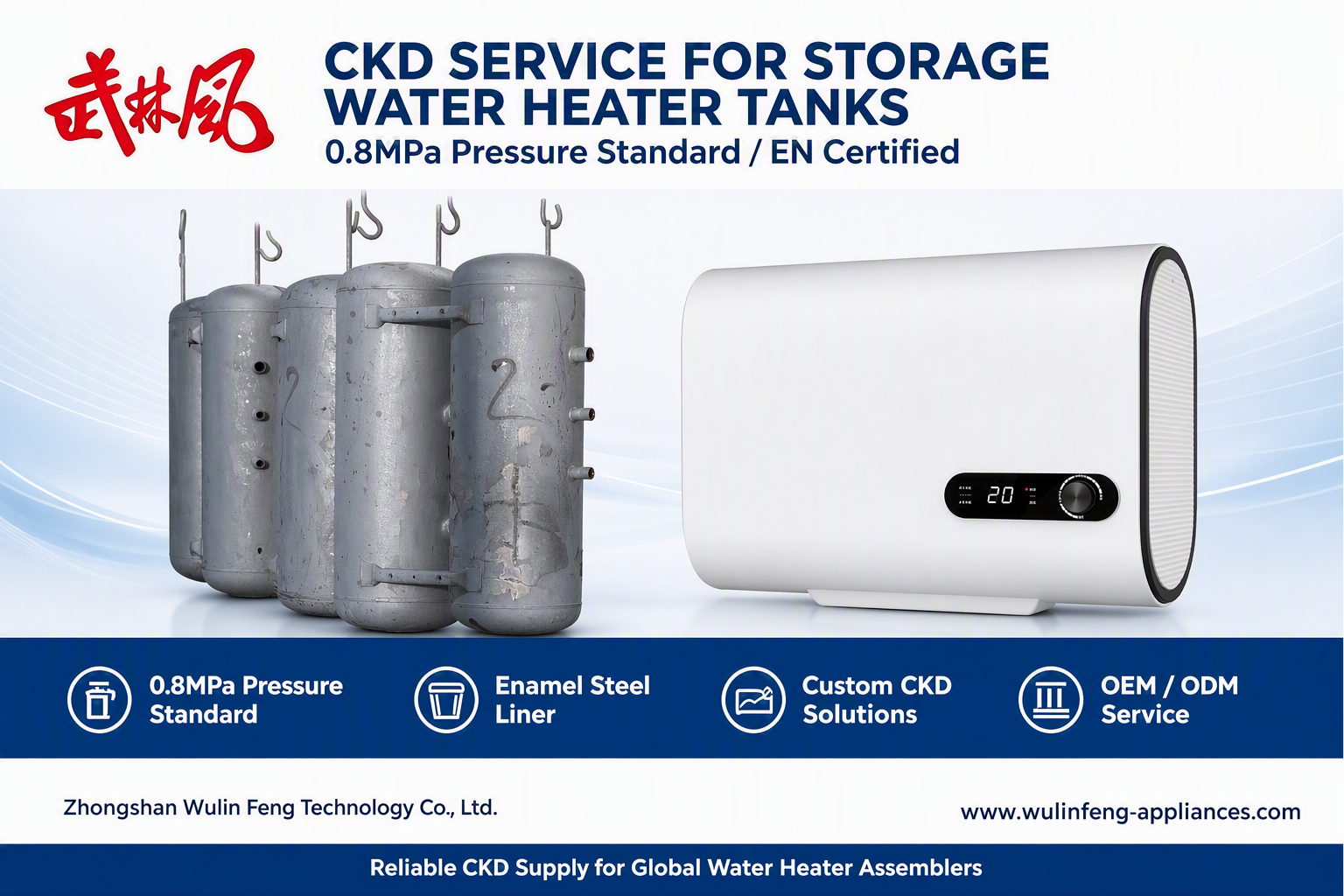
- What pressure is the liner tested to? Wulinfeng’s CKD service for storage water heater tanks is built around a 0.8 MPa pressure standard, with an enamel steel liner and EN-certified manufacturing.
- What is the enamel quality and coating process? Enamel liners are corrosion-resistant and pressure-resistant, which matters in high-frequency commercial use and in markets with aggressive water chemistry.
A supplier that cannot state a pressure standard in numbers is not giving you a specification you can hold them to.
3. Assign certification responsibility clearly
Certification is the most common source of disagreement in CKD projects, because responsibility is split between the kit supplier and the local assembler.
- What Wulinfeng already holds: CE, UL, ISO 9001, ISO 14001, and KC certifications, with a quality system covering the full production chain.
- What the buyer’s market may additionally require: local safety, energy, or import certifications, and labelling in the local language.
- What to agree in writing: which party supplies test reports and technical files, which party holds the local certificate, and which party pays for any local testing.
Components with their own approvals — thermostats, heating elements, cables, and safety devices — should be listed with their approval documents so that the local certification body can review them without back-and-forth.
4. Check the customs and duty logic before the first shipment
CKD is often chosen for tariff reasons, but the classification of an incomplete kit is not automatic. Customs authorities assess goods by their state of completeness and their essential character, so the same parts can be classified differently depending on how they are packed and presented.
Practical preparation:
- Confirm the HS heading with your customs broker before ordering — electric storage water heaters normally fall under HS 8516.10, but kit classification should be verified locally.
- Ask your broker which documents they need: bill of materials, assembly instructions, part numbers, and sometimes photographs of packed kits.
- Check whether your market has duty or incentive schemes for assembly, and what documentation proves local value addition.
- Do not assume that a lower headline duty rate applies until your broker has ruled on the specific kit.
Wulinfeng supports buyers with kit documentation, bills of materials, and packing lists so that classification can be confirmed before shipment.
5. Match the electrical configuration to your market
A kit that cannot be assembled into a sellable unit in your market is not a saving. Confirm:
- Voltage and frequency: the destination standard, e.g. 220–240 V with the correct frequency for the market.
- Power tiers: Wulinfeng’s multi-power adaptability covers 2200 W to 5000 W, which allows one kit platform to serve several market positions.
- Plug, cable, and thermostat options required locally, plus any circuit protection expectations.
- Capacity mix: plan the kit intake around the capacities your market actually sells, not a single average size.
6. Evaluate your own assembly capability honestly
CKD shifts work to your facility. Before committing to volume, confirm you have:
- Skilled staff for tank assembly, wiring, and final inspection
- Equipment for pressure testing and electrical safety testing
- A leak-testing and marking process, plus space for staging and packing
- A plan for rejected units and rework that does not break the warranty chain
If any of these are missing, SKD may be the more realistic starting point — and the supplier should be able to tell you so.
7. Insist on traceability and spare parts coverage
For a programme that runs for years, parts must be repeatable:
- Part numbers that do not change between orders
- A spare parts list covering heating elements, thermostats, safety components, and fittings
- Consistent tolerances so that kit components from different batches assemble together
- Sea-worthy packaging that protects enamel surfaces and electrical parts in humid transit
CKD kits travel further and get handled more than finished units. Packaging is part of the product.
8. Agree the quality control and inspection routine
- Pre-shipment inspection of the kit against the bill of materials
- Pressure test records for liners
- Sample kit validation before the first full order, ideally assembled by your team
- A named technical contact on the supplier side, plus spare parts sampling
Wulinfeng’s production base runs to an OKF/FOC manufacturing quality of 98.2%, with a dedicated testing centre and durability laboratory — ask for the test documentation that applies to your kit.
9. Fix the commercial terms around MOQ, tooling, and lead time
CKD conversations are also mould and tooling conversations. Wulinfeng’s service model covers drawing-based processing, full-tooling mould development, custom design, and component kits. Before signing, fix:
- MOQ per model, and how it changes once tooling is amortised
- Who owns the moulds, and what happens if the programme stops
- Lead time for the first order versus repeat orders
- Payment terms and the inspection trigger
10. Plan after-sales and documentation from day one
- Manuals and rating labels in the required language
- Warranty terms that clearly cover assembled units and who administers them
- A route for replacement parts and technical questions after the shipment
- A record of the exact configuration of every order
The short version
A CKD programme succeeds when the kit scope, liner standard, certification split, duty classification, electrical configuration, and after-sales terms are all written down before the first container. Everything else is price negotiation.
Wulinfeng Technology is an electric water heater manufacturer based in Huangpu Town, Zhongshan, Guangdong, China, supplying OEM, ODM, SKD, and CKD solutions to importers, assemblers, and brand owners in more than 50 countries. Our CKD service for storage water heater tanks covers an enamel steel liner built to a 0.8 MPa pressure standard, custom CKD kits, and full documentation support.
Send your destination market, target capacities, expected monthly volume, and assembly capability to info@wulinfeng-appliances.com, and our team will come back with a kit configuration and bill of materials.